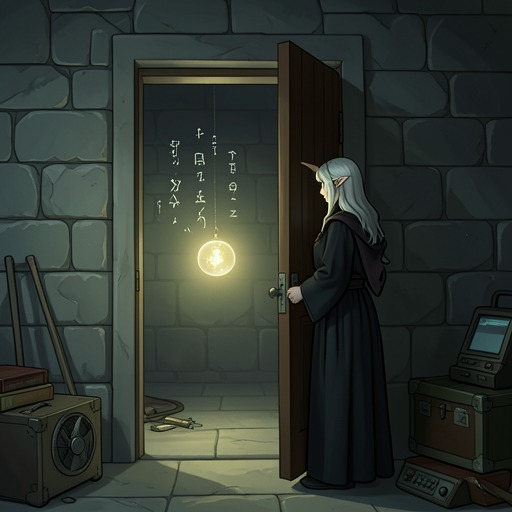
Archmage Osmian
New Life as a Max Level ArchmageArchmage Osmian stands in the history of magic as the founder of the Thaumaturgical Institute and as a measure of the distance between extraordinary mortal achievement and the incomprehensible power of the Cataclysms. His name is attached to the Institute’s impossible floating campus, to the surviving traditions of high-level magical research, and to a costly confrontation with the Colossus. Yet the same history that magnifies his accomplishments also records his failure to defeat the Cataclysms, making his legacy one of brilliance, sacrifice, and warning.
Founder of the Thaumaturgical Institute
The Thaumaturgical Institute is described as a titanic tower rising more than a hundred stories above Meridian, joined to annexes and observatories by suspended walkways. Its most spectacular feature is the campus itself: the tower rests upon a floating mass of earth and stone roughly a quarter-mile in diameter, held fifty feet above the ground by enormous chains. The enchantments defy ordinary architectural laws and appear to serve little practical purpose beyond the instinct of mages to demonstrate their power. The text directly attributes these enduring levitation enchantments to Archmage Osmian, whose work continued to shape the Institute centuries after his era.
The campus therefore functions as more than a school or research complex. It is a monument to Osmian’s conception of magic as something capable of reorganizing the physical world. Its floating foundations turn theory into permanent infrastructure, while the Institute’s height, annexes, and observatories preserve the image of an institution built to look beyond ordinary limits. Even when the narrative treats the display as magical showmanship, the achievement remains evidence of a civilization in which a single archmage could impose an impossible design upon stone, gravity, and time.
The Colossus and the Limits of Mortal Power
Osmian’s greatest recorded feat involved the Colossus, a walking mountain whose progress threatened an entire city. He did not kill the creature. Instead, he diverted it, rebuffing its advance and saving the city from destruction. The effort consumed decades of his life and left him a magical cripple. Against that immense expenditure, the visible result was almost humiliatingly small: only a scorch mark remained on the Colossus’s titanic leg.
That contrast gives the episode its historical force. Osmian’s intervention was an act of immense courage and technical mastery, but it was still defensive and temporary. He could alter the path of a Cataclysm-level being, not overcome it. The Party of Heroes later killed the Colossus, establishing a sharp distinction between Osmian’s generation of archmages and the five figures whose campaigns transformed the world within ten years. The comparison does not erase Osmian’s achievement; it places it within a hierarchy of power in which even the founder of the Institute could only delay or redirect what the heroes ultimately destroyed.
A Legacy Overshadowed by the Cataclysms
The world continues to remember the Party of Heroes because they defeated the seventh and final Cataclysm a century before the main events. Their victory cost nearly every member of the party’s life except the Sorceress, and later generations honored them through monuments, religious imagery, and the Peace Day celebrations. Osmian occupies a different position in that public memory. He belongs among the greatest mortal mages, but even his most famous accomplishment did not place him among the beings capable of ending the Cataclysmic threat.
The narrative repeatedly uses him to establish scale. Archmage Osmian is invoked alongside legends of magic that can rewrite universal laws or vaporize forests, yet the account of his encounter with the Colossus immediately qualifies such grandeur. The Cataclysms were not merely powerful monsters that a sufficiently skilled mage could defeat; they represented a level of danger that made the world’s strongest practitioners appear finite. Osmian’s sacrifice becomes a historical warning: knowledge and power can save lives, but they do not guarantee mastery over every force that magic can encounter.
Influence on Dimensional Research
Osmian’s institutional legacy becomes especially important when the Thaumaturgical Institute confronts phenomena that its established theories cannot comfortably explain. When a dimensional anomaly appears, Marcus initially rejects the possibility that other dimensions exist or that magic could interact with dimensional boundaries, describing the supposition as unsupported. The surrounding evidence later makes that skepticism untenable, and the Institute’s older intellectual framework begins to look inadequate before an unprecedented magical problem.
The contrast is sharpened by the Institute’s continued dependence on Osmian’s achievements. Its floating grounds remain suspended through enchantments he laid centuries earlier, even as later researchers struggle to interpret dimensional magic and the extraordinary defenses surrounding an unexplained door in the Institute library. The juxtaposition presents Osmian’s institution as both powerful and historically bounded: it preserves techniques capable of defying gravity, but its experts still confront anomalies that exceed their accepted categories.
Vivi’s later discussion with Archmage Aeris marks a movement beyond that inherited uncertainty. Aeris accepts that dimensional magic exists and asks Vivisari to examine his theories and experimental designs so that the Institute can prepare for another possible calamity. He acknowledges that the diagrams associated with her work have unsettled the Institute’s elite, including himself. Osmian is not shown participating in this research, but the Institute he founded becomes the setting in which his successors must respond to knowledge that challenges the boundaries of his tradition.
Historical and Thematic Significance
Osmian’s significance lies in the unresolved tension between foundation and insufficiency. He built an institution that still floats above Meridian and left behind a magical infrastructure that remains astonishing long after his death or disappearance from the active narrative. He also sacrificed decades of his life to save a city from the Colossus. At the same time, the world’s later history proves that his power could not defeat the Cataclysms, and even the heroes who surpassed his achievement are treated by some as gods because ordinary standards of strength cannot contain what they accomplished.
This makes Archmage Osmian an emblem of mortal magic at its highest credible limit. His work demonstrates that magic can reshape environments, preserve institutions across centuries, and redirect an otherwise unstoppable threat. His defeat by scale rather than by incompetence preserves his stature while exposing the danger of assuming that every unknown can be mastered through accumulated expertise. In a world where another Eighth Cataclysm may always be approaching, Osmian’s legacy is therefore double-edged: the Institute represents humanity’s confidence in knowledge, while the scorch mark on the Colossus represents the boundary that knowledge has not yet crossed.